
I Sea 10! is a fantastic game for helping young children work on counting, addition and subtraction, and especially making 10. You know, learning that 6+4=10, or 3+7=10. Really knowing how to make 10 makes it much easier to add double-digit (and larger) numbers later in life.
This post may contain affiliate links, meaning if you click on it and make a purchase I’ll receive a small commission at no cost to you. As an Amazon Associate, I earn from qualifying purchases. For more information, please check our Privacy Policy and Disclaimers and Disclosures.
If you have young children, I Sea 10 is an excellent game to invest in! We got it when my youngest was 4, and she absolutely loved it for about 2 years. This is a versatile game, so you could continue to use it as your kids get much older. We have other game options so our game doesn’t get used so much anymore.
It’s only a small cardboard box with a bunch of cardboard tokens. Due to its simplicity, it could be easily DIY’d, but I really prefer a more professional look, don’t you? My kids also do. Anyway, on one side of each token is a cute cartoon ocean animal; sea stars, fish, octopi, and sea turtles. On the other side, most of the tokens have a number from 1-9, but some have a shark!
How to play I Sea 10!
The way the instructions tell you to play the game, you take turns flipping over 1 token at a time. Anytime someone is able to make 10, they call out “I Sea 10!” and keep those tokens. But, if you flip over a shark token, you’re supposed to return the shark token, plus all the tokens you’ve collected, to the box. We’ve never been able to use the shark tokens this way. They’ve either had to be left in the box and not used at all or wild (any number).
The game comes with a few ideas for expanding gameplay, including making 20 instead of 10, setting a timer with the winner being the one who collected the most stacks, and playing until a player gets to 10 stacks of 10.
For younger kids working on number recognition, you could use the tokens for matching, or like fun flashcards and just have them name the numbers they turn over. For more advanced math students, you could use the tokens like you were playing Math Dice.
Also great for making your own games!
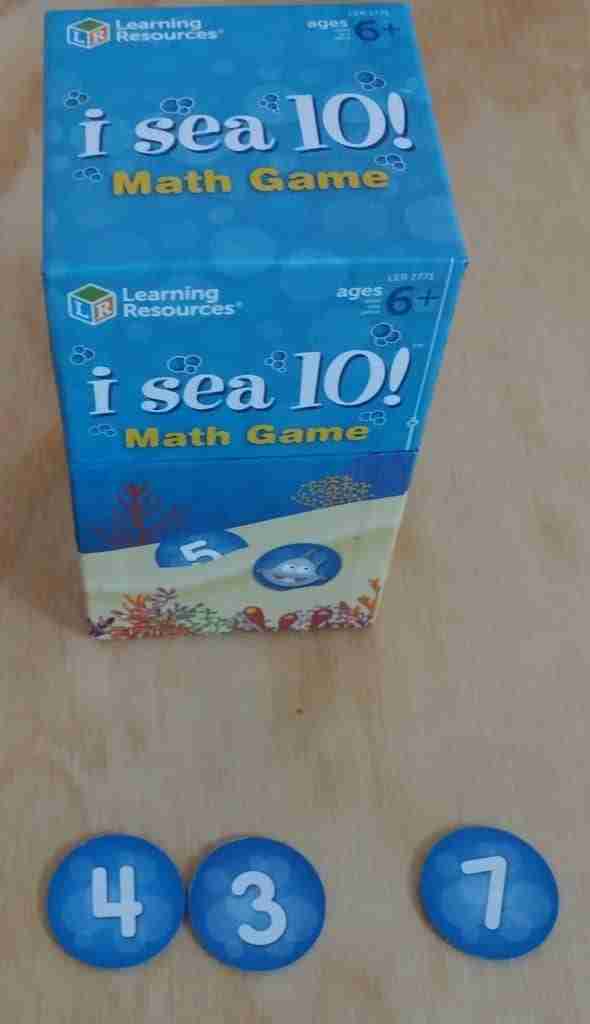
Once my daughter outgrew the published rules, she LOVED using this game to design her own game. As the younger sibling, continually being bossed about by her big brother, I’m pretty sure she reveled in the power of being in charge. I loved that it helped her think things through. You know how when little kids design a game, they’re constantly changing the rules, and adding new ones? Well, I’m not a fan of that. So when we’d start a new game, I’d think of as many different scenarios as I could to ask her about how her rules applied to them. It made her think things through, and that meant we generally started the game with pretty fleshed-out rules, which meant fewer frustrations while we played.
One of my daughter’s favorite ways to play was to flip over a certain number of tokens and build an equation with them. Variations revolved around how many tokens you flipped over, what happened if you couldn’t make an equation, what operations were allowed, if you had to use all your tokens, and the sharks. If the sharks were used, they were often wild.
For really advanced math students who are still young enough to enjoy the silly artwork, you could use these tokens for building algebraic equations. However, since you’re lacking any operation tokens at all, you may be better off with a game of Math Scrabble, either DIYed or one of the many purchased options.
All in all, even though this is a simple game, due to its versatility and low price point, I call I Sea 10! a winner! Still unsure? Check out our YouTube video of a couple of different play-throughs. My kids are older now, but you’ll get the idea.